


Key takeaways
- A Forward Deployed Engineer (FDE) is a customer-embedded software engineer who deploys, customizes, and operationalizes complex products inside a live company environment.
- Companies hire FDEs to close the last-mile gap between a platform and real workflows, data, and systems, the point where most AI and enterprise software projects stall.
- Upverse offers FDEs as dedicated staff-augmentation resources, so you get an embedded engineer on your team without standing up an internal FDE function from scratch.
- An Upverse FDE writes production code, integrates systems, and owns outcomes. They are not a demo specialist, a ticket queue, or a shared consultant hopping between accounts.
Definition
What is a Forward Deployed Engineer?
A Forward Deployed Engineer (FDE) is a customer-embedded software engineer who works inside a company's real environment to deploy, customize, integrate, and operationalize complex software. The FDE full form is Forward Deployed Engineer. Some teams also use forward-deployed software engineer or customer-embedded engineer for the same idea.
The distinguishing feature is where the work happens. Internal product engineers build generic capability for every user. An FDE works against one customer's data, APIs, identity, and workflows so that capability actually lands in production. The job is production work, not a demo, a prototype, or a ticket passed back to a remote team.
Simply stated, a Forward Deployed Engineer knows both the technical and business problem, adapts software to the actual deployment, connects internal engineering to outside users, and stays until the system produces a measurable result. When the operating model calls for it, FDEs also shape the product by returning field patterns to the core team.
Operating model
What is forward deployed engineering?
Forward deployed engineering is an operating model that places engineers close to the business problem, physically or operationally, instead of keeping them centralized behind a requirements document. Engineers embed in customer environments, pilot projects, early production rollouts, and high-impact use cases.
Proximity creates clarity. When an engineer sees how the process truly runs, they can validate assumptions with working software, adapt as constraints appear, and deliver value in days or weeks rather than after a long build that misses the real workflow. The model is especially useful when products are highly customizable, customer environments differ widely, use cases cannot be fully predicted in advance, and time-to-value is critical.
That is why demand for the role has grown with AI, agents, and integration-heavy platforms. The hard problem is no longer only building another model or buying another tool. It is making technology work inside day-to-day operations, with all the complexity that comes with them. Forward deployed engineering is the response to that last-mile gap.
Why it matters
Why companies hire Forward Deployed Engineers
Research on generative AI in business has found that most projects fail to deliver measurable ROI. The usual cause is not the model. It is brittle workflows, poor fit with how work actually happens, and a gap between what technology can do and what the organization can operationalize. Hiring an FDE is how you staff that gap.
01
The last mile is where AI projects fail
A model or platform can look strong in a demo and still fail once it meets messy data, legacy systems, identity rules, and undocumented workflows. A Forward Deployed Engineer works at that last mile: wiring software into the environment where value has to appear.
02
Requirements are incomplete until someone is inside the work
Enterprise problems rarely arrive as clean specifications. Hidden exceptions, tribal knowledge, and political constraints show up only when an engineer sits with operators. FDEs discover the real problem while they build, which is faster than waiting for another round of discovery documents.
03
Internal engineering cannot absorb every customer-shaped problem
Product and platform teams are measured on the roadmap. When every integration, data issue, and edge case is escalated back to them, delivery slows and the core product stalls. A dedicated FDE absorbs field work so your builders can keep building.
04
Buyers pay for outcomes, not features
Enterprise customers and internal stakeholders judge success by time-to-value, adoption, and operational results. An FDE turns a promised workflow into a running system, then stays close enough to iterate until the outcome is measurable.
Decision signals
When you should hire a Forward Deployed Engineer
You do not hire an FDE because the title is popular. You hire one when customer or internal outcomes depend on engineering-level involvement in a live environment. If two or more of the following show up repeatedly, you are looking for a dedicated FDE, not another round of remote tickets.
Integrations and data are blocking go-live
The product is bought or the AI use case is approved, but production depends on APIs, identity, warehouses, ERPs, or CRMs that were never designed to talk to each other. Configuration-only teams hit a wall. An FDE builds the path through.
AI features break on real-world data
Agents, copilots, and automation look reliable on sample data and then fail on incomplete records, conflicting definitions, or workflow exceptions. An FDE tunes the system against live inputs and the decisions people actually make.
Your engineers keep getting pulled into customer delivery
If product engineering is the unofficial implementation team, you already have an FDE-shaped problem. Staffing a dedicated resource restores focus and gives delivery a named owner.
Strategic accounts need custom logic to reach value
Large customers expect the software to fit their process, not the reverse. An embedded engineer can extend, adapt, and operationalize the product without turning every request into a six-week escalation.
You need production capacity now, not after a 90-day hire
Building an internal FDE function is slow because the hybrid skill set is scarce. Staff augmentation lets you place a dedicated Upverse FDE with your team while you decide whether to grow that capability in-house.
Workflows are high-stakes, regulated, or highly variable
Healthcare, finance, logistics, operations, and other environments where mistakes are expensive need engineers who can work inside real constraints, not against an idealized architecture diagram.
Role clarity
Forward Deployed Engineer vs other roles
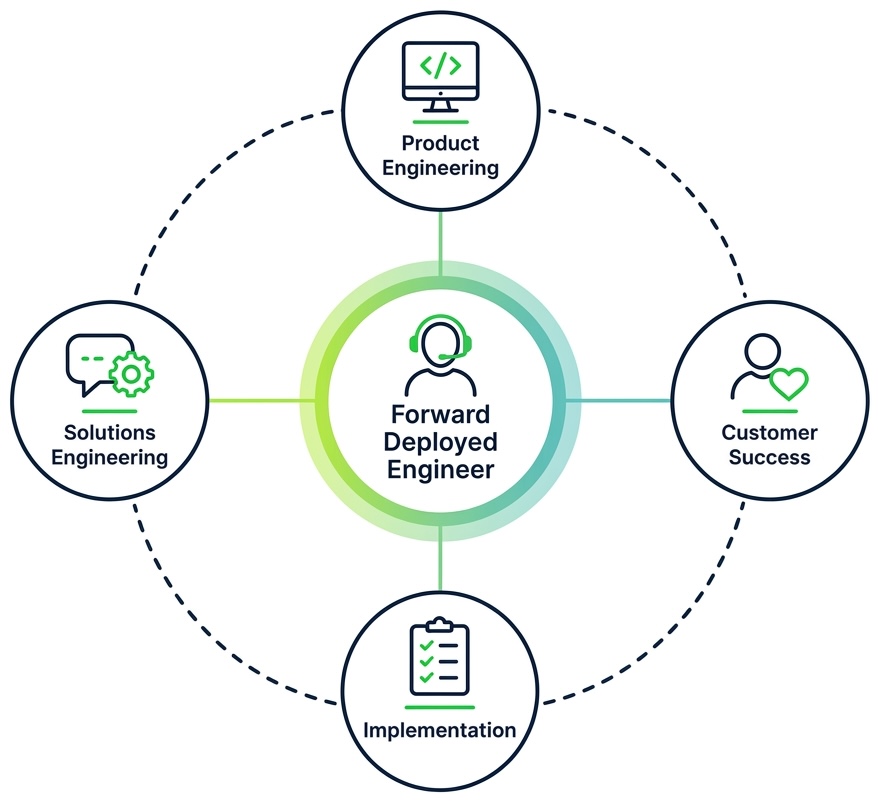
The FDE title sits between product engineering, solutions engineering, implementation, and customer success, but it is not a relabeling of those jobs. Other roles often work around the product. An FDE works inside it, in the customer's reality, until the outcome is live.
Software engineer
Core product development
Builds generic capability for every user. Limited exposure to one customer's live systems, data, and workflow constraints.
Solutions engineer
Pre-sales technical support
Wins the deal with demos and proofs of concept. Rarely owns production delivery after the contract is signed.
Implementation or CS engineer
Onboarding and configuration
Guides rollout of what the product already supports. Stops when the work needs production code, custom integrations, or product gaps filled.
Consultant or professional services
Bespoke project delivery
Can build custom outcomes, but often sits outside your product loop and leaves when the statement of work ends.
Forward Deployed Engineer
Production delivery in the customer environment
Writes production-grade code, embeds with the team, and owns the outcome until the system works in real conditions.
The practical test is simple. If the person cannot write production code, they are not an FDE. If they never sit with the customer's systems and users, they are not an FDE either. You are hiring both halves of that hybrid.
Scope of work
What an Upverse Forward Deployed Engineer actually does
An Upverse FDE is a builder embedded with your team. They take responsibility from discovery through production, then stay long enough for the system to be used, trusted, and handed off. Typical work includes:
01
Discover how the work actually happens
Map systems, data, roles, exceptions, and decision points by working with the people who run the process, not only the people who sponsored the project.
02
Design a solution that fits the environment
Choose what to configure, what to integrate, what to customize, and what should never be a one-off. Product judgment is part of the job.
03
Build, integrate, and ship to production
Write code, connect APIs, repair data paths, handle identity and permissions, and deploy into the customer's real stack.
04
Debug in live conditions
Fix the issues that only appear against production-like data, proxies, and workflow exceptions, then ship the fix without a long handoff chain.
05
Enable the team that has to run it
Train operators, document the deployment pattern, and leave a system the customer team can operate, monitor, and extend.
06
Feed field learning back into the product
Surface repeatable gaps so your roadmap improves for every customer, instead of hiding the same workaround in five private forks.
Capability
Skills you get when you hire an Upverse FDE
Great FDEs are rare because the role asks for engineering depth and customer-facing judgment in the same person. Upverse staffs that hybrid so you do not have to recruit, train, and retain it from zero.
Production software engineering
FDEs write, debug, and operate code that has to hold up in someone else's environment. The output is not a slide, a prototype, or a sandbox demo.
Systems integration
Most of the work is connecting platforms to existing APIs, data pipelines, identity systems, warehouses, and internal tools that were never designed as a clean suite.
Applied AI in real workflows
For AI-heavy engagements, the value is not the model alone. It is grounding the model in the customer's data, tools, evaluation, and human-review points.
Translation between business and engineering
Stakeholders describe outcomes. Systems impose constraints. An FDE turns ambiguous requests into something shippable, then explains trade-offs in plain language.
Product judgment
The role includes deciding what to customize for one environment versus what should become a reusable pattern. Unchecked one-offs create debt. Over-standardizing delays value.
Autonomy in undefined problem spaces
FDEs often work without a complete spec, a dedicated local team, or a stable set of requirements. Comfort with ambiguity is as important as any framework.
How we staff
Hire an FDE as a dedicated resource
Upverse offers Forward Deployed Engineers to your company through a dedicated engagement model. You are not buying a workshop, a shared consultant, or a ticket-based support seat. You are hiring a dedicated FDE who works as part of your company for the length of the engagement.
That dedicated model matters. FDEs lose leverage when they are split across too many accounts, treated as a dumping ground for every escalation, or asked to run demos instead of shipping software. We match one engineer (or a small pod, when the scope needs it) to your outcome, your stack, and your working rhythm.
Companies use this when they need production AI or integration capacity faster than a full-time hire, when a strategic workflow is blocked, or when they want to prove an FDE motion before building the function internally. You keep ownership of the problem. The FDE supplies the embedded engineering to solve it.
Business value
The metrics Forward Deployed Engineers move
Leadership does not hire an FDE to add another role to an org chart. They hire one because delayed implementations, shallow adoption, and stalled AI programs show up in the numbers that already matter.
Time-to-value
Technical blockers, messy data, and missing integrations are the usual reasons go-lives slip. An FDE removes those blockers in the field instead of waiting on a remote engineering queue.
Adoption depth
Launching a tool is not the same as weaving it into daily operations. FDEs fit the system to the real workflow, which is what makes people actually use it.
Usage and quality for AI systems
AI products only perform as well as the data they ingest, the workflows they support, and the evaluation around them. FDEs tune all three against live conditions.
Expansion and retention
When a strategic workflow is stuck, renewal risk rises and expansion stalls. Unblocking that workflow protects revenue that a delayed implementation can quietly put at risk.
Product learning speed
Field patterns, edge cases, and unspoken requirements reach the roadmap faster when an engineer is already inside the customer environment.
Engagement
How an Upverse FDE engagement works
Forward deployed engineering follows a simple idea: you cannot fix what you do not understand. The work moves from context, to a fitted design, to software running in the environment that has to live with it.
- 1
Scope the outcome
You share the business problem, systems involved, constraints, and what success looks like. We do not start from a generic talent request. We start from the result you need in production.
- 2
Match a dedicated FDE
Upverse assigns a Forward Deployed Engineer as a dedicated resource to your company. They work as part of your team, inside your tools, rituals, and environment.
- 3
Embed and discover
The FDE spends the first stretch learning how the work really runs: data, integrations, exceptions, owners, and the gap between the stated process and the lived one.
- 4
Ship in the customer environment
They build, integrate, test, and deploy against real systems. Value shows up as working software, not a recommendation deck.
- 5
Harden, enable, and hand off
As the system stabilizes, the FDE documents the pattern, trains your team, and leaves you able to operate what was built. You can extend the engagement if the next outcome still needs an embedded engineer.
Who FDE staff augmentation is for
Who it's for
- · Product and AI companies that need an engineer inside a strategic customer environment
- · Enterprises operationalizing AI, agents, or automation against messy data and legacy systems
- · Teams whose core engineers are consumed by roadmap work and cannot absorb field delivery
- · Leaders who need dedicated FDE capacity faster than a full-time hiring cycle
Who it's not for
- · Teams that only need configuration, training, or a standard onboarding checklist
- · Organizations looking for a demo specialist or a short-lived proof of concept with no production path
- · Projects with no internal owner to maintain the system after the FDE rolls off
- · Low-stakes experiments that do not justify high-touch, dedicated engineering
Forward deployed engineering is also the wrong fit when you are asking for unbounded custom software with no product or platform to extend. In that case you want a delivery team, not an embedded FDE. Upverse can discuss either motion. The Hire an FDE path is specifically for dedicated, customer-embedded engineers.
When you should not force the FDE model
The work is standard configuration
If your systems are clean, documented, and easy to connect, an embedded engineer adds cost without adding much leverage. A strong implementation or customer success motion may be enough.
There is no owner after the engineer leaves
FDE work pays off when someone inside the company can maintain and extend it. If there is no internal capacity to own the result, the system fades the moment the engagement ends.
You want a one-off custom product with no reuse
Staffing an FDE is the wrong shape for a fully bespoke build that will never touch a product or platform. That is a software delivery engagement, which Upverse also does, but it is a different motion.
The use case is too small to justify high-touch engineering
Dedicated FDEs belong on high-impact workflows: revenue, cost, risk, or a strategic customer outcome. A low-stakes experiment does not need this model.
Forward Deployed Engineer FAQ
Direct answers for teams evaluating whether to hire an FDE, how the role works, and how Upverse staffs dedicated Forward Deployed Engineers.
What is a Forward Deployed Engineer (FDE)?
A Forward Deployed Engineer is a software engineer who embeds with a customer team to deploy, customize, integrate, and operationalize complex software in that customer's real environment. FDE stands for Forward Deployed Engineer. The role combines production engineering with direct customer collaboration, so the product works under live constraints rather than in a demo.
What does a Forward Deployed Engineer do day to day?
An FDE gathers requirements from users in the field, designs a solution that fits the customer's systems, writes production code, integrates APIs and data, debugs live issues, and iterates until the workflow is usable. In AI engagements they also ground models and agents in real data, evaluation, and human-review steps. Many FDEs send field insights back to product so the platform improves for everyone.
How do I hire a Forward Deployed Engineer from Upverse?
Upverse offers FDEs as dedicated staff-augmentation resources. You tell us the outcome, systems, and constraints. We match an FDE who embeds with your team and works inside your environment. Start by booking a conversation through the Hire an FDE call to action. We will scope the work, the profile, and the engagement length together.
How is an FDE different from a software engineer?
Software engineers primarily build and maintain a core product for many users. Forward Deployed Engineers still write production-grade code, but they do it inside a specific customer environment, against that customer's data, identity, and workflows. The FDE is measured on whether the deployment works in production, not only on whether a feature shipped.
How is an FDE different from a solutions engineer?
A solutions engineer typically supports pre-sales with demos, architecture discussions, and proofs of concept. A Forward Deployed Engineer typically owns post-sale production delivery: building integrations, fixing data issues, and operating the system in the customer environment. At smaller companies one person may do both, but the FDE's defining trait is shipping and running real software, not presenting it.
Is a Forward Deployed Engineer the same as a consultant?
Not exactly. Consultants and professional services teams can deliver bespoke outcomes, but they often sit outside the product loop and leave when the project ends. An FDE is an engineer embedded with your team, writing production code, and (when the engagement calls for it) feeding what they learn back into the product or platform. Upverse staffs FDEs as dedicated resources, not as a rotating advisory bench.
Do Forward Deployed Engineers write code?
Yes. Production-grade engineering is the core of the role. FDEs build integrations, customize workflows, repair data paths, debug live systems, and ship fixes. They also communicate with stakeholders and shape requirements, but they are builders, not demo specialists or project coordinators.
When should a company hire a Forward Deployed Engineer?
Hire an FDE when the product or AI system has to work inside complex, messy, or high-stakes environments, and standard onboarding is not enough. Common signals include blocked integrations, AI features that fail on real data, engineering teams pulled into customer delivery, strategic accounts that need custom logic, and a need for production capacity faster than a full-time hire cycle.
Is forward deployed engineering only for AI companies?
No. The model is especially valuable for AI, agents, and automation because those systems only create value once they are wired into real workflows. Any company dealing with complex integrations, high workflow variability, or mission-critical operations can benefit from an FDE, including enterprise software, data platforms, and internal transformation programs.
What is FDE staff augmentation?
FDE staff augmentation means you hire a Forward Deployed Engineer as a dedicated resource from Upverse rather than recruiting that hybrid profile yourself. The engineer embeds with your company, works in your environment, and is accountable for production outcomes. You get FDE capacity without building, ramping, and managing an internal FDE function first.
Do Upverse FDEs work onsite or remotely?
Embedding is operational first: the FDE works in your systems, with your team, against your real constraints. Some engagements need onsite time, especially in regulated or high-stakes settings. Others run remotely with tight collaboration. We match the working model to the environment, the data, and the stakeholders involved.
How long does an FDE engagement last?
Length follows the outcome. Some companies need a dedicated FDE through a critical go-live and handoff. Others keep an FDE embedded while they scale a portfolio of AI or integration work. We define scope, success measures, and an exit or extension path up front so the resource does not become an undefined crutch.
What skills should I look for in a Forward Deployed Engineer?
Look for strong software engineering fundamentals, systems integration across APIs and data, production debugging, and enough product judgment to know what to customize versus standardize. Communication matters as much as code: the FDE has to turn ambiguous business problems into technical work and explain trade-offs to non-engineers. For AI deployments, add fluency with models, evaluation, and workflow design.
Can I hire an FDE instead of building an internal team?
Yes. Many companies start with a dedicated Upverse FDE to prove the motion, cover a strategic account, or unblock a production AI workflow. If the need is ongoing, you can keep the resource, expand to a small pod, or use the engagement as a blueprint for hiring internally later. Staff augmentation is often the fastest way to get the skill set into the building.